AI Will Not Replace Sales Judgment
The fear is misplaced: AI won’t replace judgment The real worry isn’t that AI will replace a seller’s judgment (reading the room, sensing slippage, choosing the next move). It won’t. AI is exceptionally strong at the mec
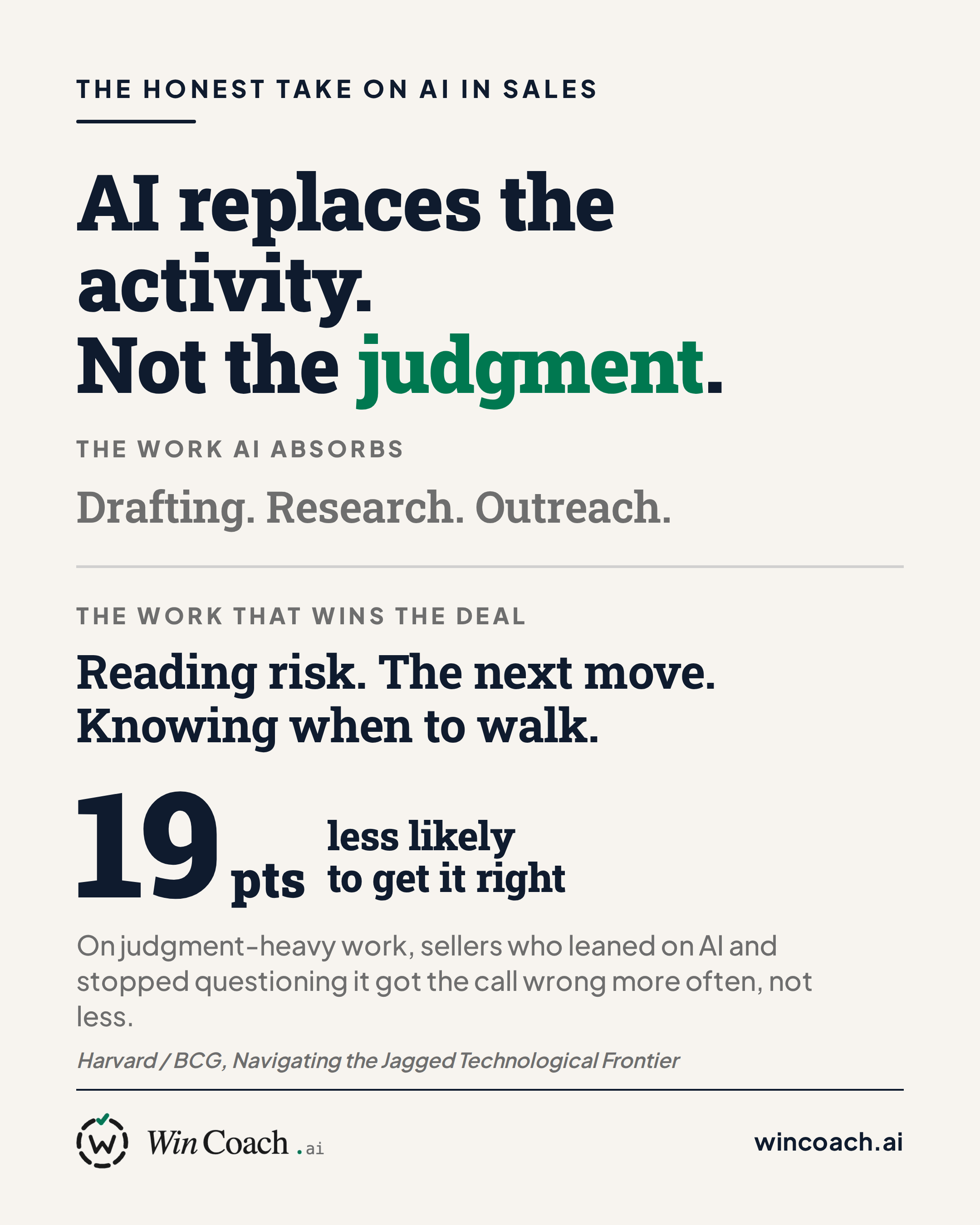
The fear is misplaced: AI won’t replace judgment
- The real worry isn’t that AI will replace a seller’s judgment (reading the room, sensing slippage, choosing the next move). It won’t.
- AI is exceptionally strong at the mechanical layer of selling.
- That mechanical layer is exactly what low-judgment sellers were competing on - so AI threatens them, not the high-skill seller the headlines imply.
What AI is actually doing in sales today
According to Salesforce’s State of Sales report (and consistent with HubSpot):
- Reps spend ~28–30% of their week actually selling; ~70% is admin, data entry, research, and internal meetings.
- ~81% of sales teams are experimenting with or have implemented AI.
- Much of “reasoning/agentic” AI is aimed at automating the non-selling 70%.
- The most common use is drafting outreach/content; far fewer sellers use AI to qualify deals.
- Net: AI augmentation is real but it primarily boosts activity/output, not deal judgment.
AI helps, until it doesn’t
Evidence from a large BCG field experiment (758 consultants):
- On tasks that fit the model’s strengths:
- Quality improved by ~40%. - Speed improved by ~25%. - The weakest performers benefited most (a “gap-flattening” effect).
- On tasks outside the model’s strengths (ambiguous, conflicting signals, judgment calls):
- AI users were 19 percentage points less likely to reach the right answer. - The failure mode wasn’t “AI makes mistakes.” It was “people accept fluent output and interrogate it less.”
- That boundary is the jagged technological frontier: it’s hard to tell which side you’re on, because the AI sounds equally confident either way.
How this shows up in real deals
- A seller can run a “textbook process”:
- Clean sequences - Tidy call summaries - Crisp AI-drafted follow-ups - A CRM that looks healthy
- And still lose to no decision.
- Research (Dixon & McKenna, 2.5M sales conversations):
- ~40–60% of deals are lost to customer indecision. - Once buyers have intent, the blocker is often fear of getting it wrong (more than fear of missing out).
- The seller’s activity can be excellent while the core judgment call, surfacing and defusing that fear never happens.
The real danger
- The biggest risk isn’t that AI gets things wrong, it’s that it gets them wrong fluently.
- Sellers without judgment can’t reliably detect when AI output is misleading.
- Research on AI “validation” behavior shows that when challenged, models can:
- Apologise, then restate the same claim - Add more supporting detail (even when the underlying claim is wrong)
- Generic AI tends to manufacture reassurance: it’s optimized to sound helpful, not to clearly say “I don’t know.”
Why the augmented seller wins
- Pure-instinct seller: judgment, but no leverage → drowns in the non-selling 70%.
- AI-only seller: leverage, but no judgment → ships polished, plausible deals into “no decision.”
- Augmented seller: uses AI to remove mechanical work and sharpen the judgment call → outperforms both.
- The highest performers treat AI as a thinking partner in constant dialogue—not as a replacement for thinking.
What AI should be in a deal: a structured thinking partner
- The right role for AI is to augment judgment, not merely generate content.
- Two requirements:
1) Methodology-aware prompts that force the right deal-review questions so the judgment call doesn’t get skipped.
2) Honest friction: willingness to say the deal is at risk or that there isn’t enough evidence rather than invent reassurance.
- “An AI that only agrees with you isn’t a coach. It’s a mirror with better grammar.”
WinCoach (application of the idea)
- The team captures what they actually know in plain language (not just system logs).
- A proprietary framework (28 dimensions across 7 pillars of deal winnability) reads the signals.
- It returns the next best move tailored to the asker (seller, manager, or leader).
- It refuses to fabricate; when evidence is thin, it says so and tells you what to find next.
Conclusion
- AI isn’t the end of the skilled seller.
- It’s the end of the seller who confuses activity with skill.
- With judgment, AI is unprecedented leverage; without judgment, it quietly exposes the gap.