As a sales leader you are accountable for outcomes that you often cannot directly influence
Every sales manager lives with the same quiet contradiction. You carry the number. You will be asked, every quarter, why it landed where it did. And yet you cannot close any of it yourself. The deals belong to your sales
Every sales manager lives with the same quiet contradiction. You carry the number. You will be asked, every quarter, why it landed where it did. And yet you cannot close any of it yourself. The deals belong to your sales team. You can sit in on a call, read a deal notes, ask a sharp question in the one-to-one. But the moment that matters, the conversation that actually moves the buyer, happens when you are not in the room.
That gap between what you are accountable for and what you can directly touch is the real job. It is also the source of most of the anxiety in the role.
You cannot work every deal. The one thing you can actually move is the judgment your sales team bring to each deal. So that is where your leverage is, and almost everything else is a distraction from it.
The maths.
The average frontline sales manager has roughly seven to nine direct reports and spends about 9% of their time developing them (Gartner). In some organisations spans are widening further, towards twelve to fifteen reports, as companies flatten layers (McKinsey case evidence, directional). At the same time, sellers spend less than 30% of their week actually selling, around 28 to 30%, with the rest lost to admin, internal meetings, and data entry.
The reality is you are responsible for the output of seven to nine people who are themselves only selling a third of the time, and you can personally be present for a sliver of it. You will never out-work that maths by doing more deals yourself. The only input that scales across all of it is the quality of the decisions your sales team make when you are not there.
What the pressure does to good managers.
Consider this that will be familiar from your own pipeline. A large deal is slipping in the last three weeks of the quarter. The sellers read feels thin. You are accountable for the number, so you do the natural thing. You step in and you pull it over the line.
It looks like a save in one narrow sense it is. But look at what it cost. The rep did not build the judgment that closed it, so the next hard deal lands straight back on your desk. You have made yourself the dependency. And while you were rescuing one deal, the other eight got none of your attention.
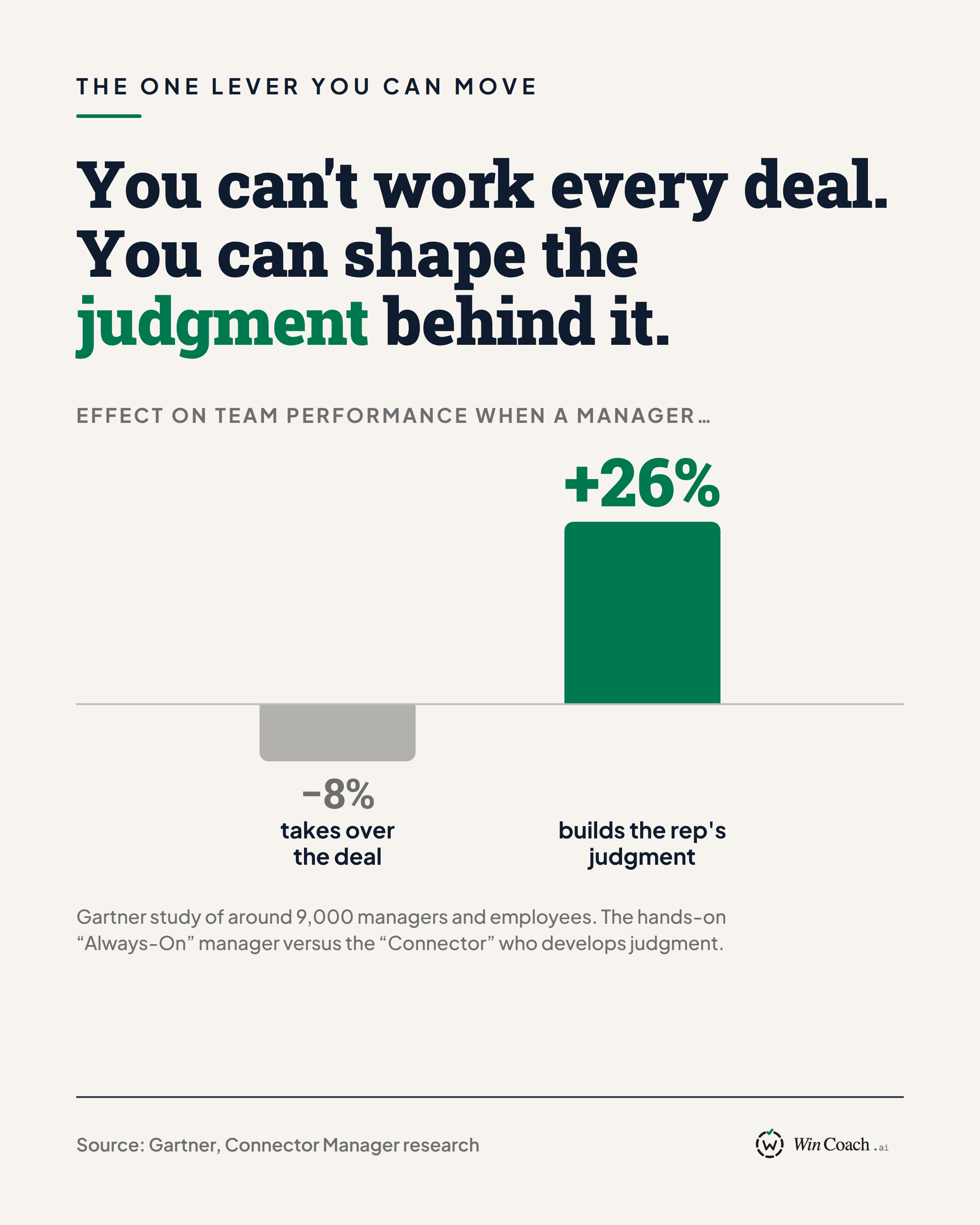
Gartner's research on how managers develop people puts a number on this instinct. Drawing on a study of roughly nine thousand managers and employees, they found that the "Always-On" manager, the one who gives constant hands-on feedback and jumps into the work, actually degrades team performance by up to 8%. The manager who does the most can produce less than the manager who does the right thing.
The distinction most people miss is between working a deal and building judgment.
Working a deal is a one-time return. You win this one, and nothing transfers. Building judgment is a return that compounds. A seller who learns to read a stalling deal correctly applies that read to every deal they run for the rest of their time on your team.
The same Gartner research names the manager who gets this right. The "Connector" does not try to know everything or do everything. They ask the right questions, give tailored feedback, and connect reps to the help they need. Connector managers improve performance by up to 26% and roughly triple the likelihood that a report becomes a high performer. That is the whole argument in one contrast. Take over the deal and you are down 8%. Build the judgment behind it and you are up 26%.
This is why coaching, done properly, shows up so clearly in the numbers. Korn Ferry, formerly CSO Insights, links consistent coaching to materially higher win rates and quota attainment, with reported gains running from around 14 to 15% in some studies to considerably higher where coaching is dynamic and measured. The Sales Management Association has reported that effective coaches produce teams with roughly 19% higher year-on-year revenue growth (directional). The effect is not about volume. It is about consistency and specificity.
So if judgment is the lever, the practical question is how you get hold of it.
You cannot coach what you cannot see.
Most managers can see outputs. The stage. The close date. The forecast category. What they cannot see is the reasoning underneath. Why does the rep believe this deal will close? What are they assuming about the buyer's timeline, the competition, the people who have gone quiet? Where is their read optimistic, and where is it simply missing? Without that, coaching collapses into generic advice ("be more consultative", "create urgency"), and generic advice moves nothing.
The fix, in principle, is threefold. Make each rep's reasoning on a deal visible, not just their forecast. Coach that reasoning deal by deal, anchored to the real deal in front of you rather than to abstractions. And do it consistently across the team, so you are coaching the pattern rather than fire-fighting the one deal that happens to be on fire today.
This is the problem WinCoach is built to solve.
The deal team captures what they actually know about a deal in plain language, through a step we call "Tell WinCoach". A proprietary framework of twenty-eight dimensions across seven pillars of deal winnability reads those signals and returns a synthesised next best action, written for the role that is asking. For a manager, that turns the invisible visible. You can see where a rep's read on a deal is thin or optimistic, which deal carries the most risk, and which person most needs the conversation this week. You coach the judgment across every deal at once, rather than working one deal by hand and hoping the lesson sticks. Forecasting tools give you a score. Conversation tools tell you what was said. WinCoach is built to show you the quality of the thinking, which is the one thing you can actually coach.
That is what it means to line accountability up with influence. You stop trying to control outcomes you cannot reach, and you start moving the single input that shapes all of them.
You are still accountable for the number. That will not change. What can change is whether you spend the quarter chasing deals you cannot personally close, or building the judgment that closes them whether you are in the room or not.