Build The Mutual Action Plan Your Buyer Actually Wants
Most Mutual Action Plans Are Built for the Wrong Person Most mutual action plans fail for a reason nobody likes to say out loud. They are built for the seller, not the buyer. They track where the deal sits in our funnel.
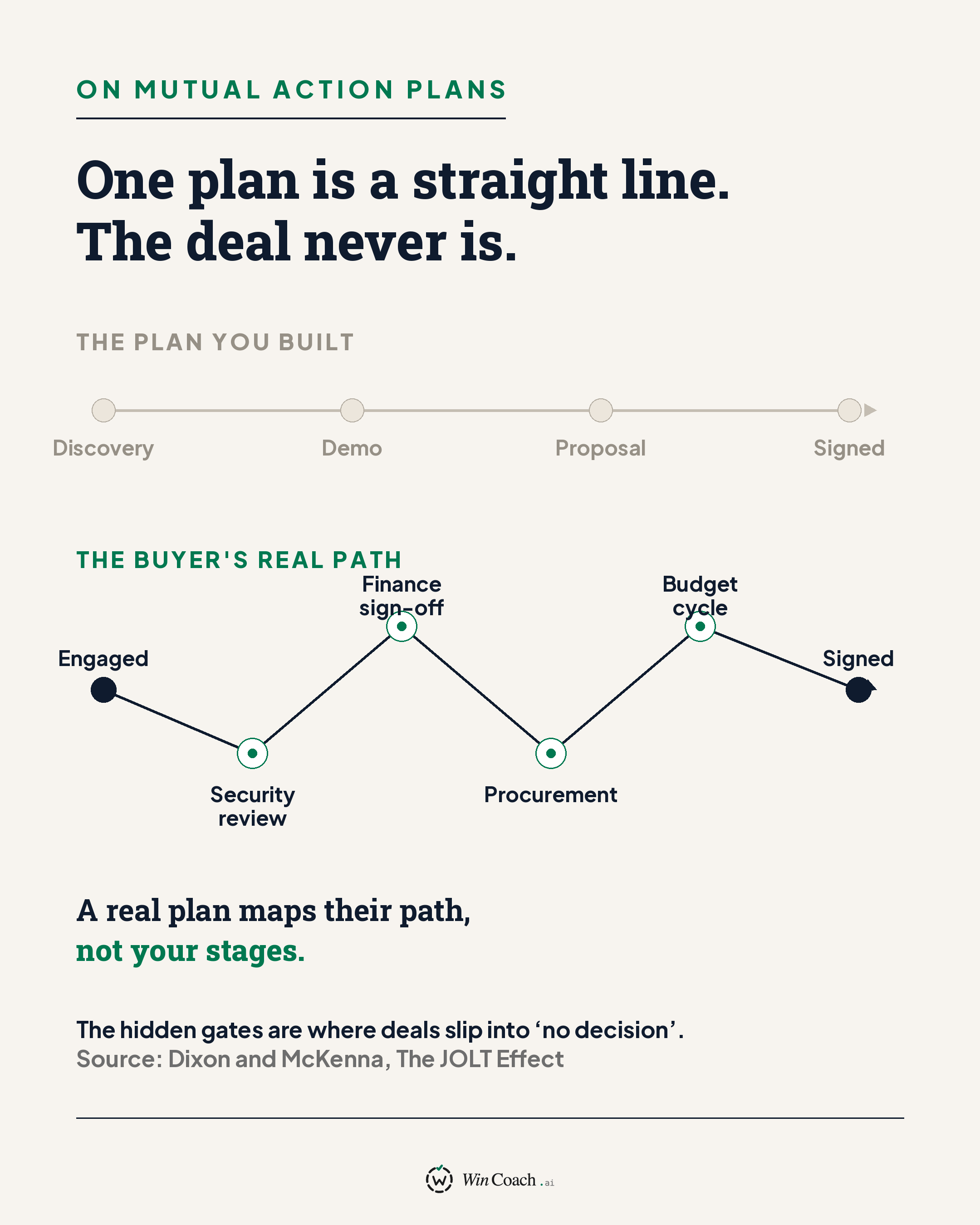
# Most Mutual Action Plans Are Built for the Wrong Person
Most mutual action plans fail for a reason nobody likes to say out loud.
They are built for the seller, not the buyer.
They track where the deal sits in our funnel. They use our stages, our internal gates, our forecast categories, and our language. Then we send the plan to the buyer and wonder why they never open it again.
They do not open it because it was never really for them.
The plan your buyer actually wants does a different job. It does not track them. It helps them buy.
The Buyer Is Dealing With More Complexity Than We See
Start with the buyer’s reality, because that is where this issue really matters.
Gartner found that:
- 77% of B2B buyers said their most recent purchase was very complex or difficult.
- The typical buying group for a complex solution involves six to 10 decision makers.
- Each decision maker often arrives with four or five pieces of information they have gathered independently.
- Around 90% of buying groups revisit at least one buying task as new information emerges.
- Buyers spend only about 17% of their total buying time with potential suppliers.
- When they are comparing suppliers, the time spent with any single rep can fall to five or six percent.
Read those numbers together.
The buyer is trying to navigate something genuinely difficult, mostly without us in the room.
So when we give them a plan that simply maps our sales process onto their buying challenge, it is not just unhelpful. It is irrelevant to the problem they are actually trying to solve.
Buyer Enablement Is the Real Job
Gartner calls the useful work “buyer enablement”.
In simple terms, buyer enablement is the information, guidance, and structure that helps a customer complete the critical jobs involved in buying.
That matters because Gartner’s research also found that buyers who see a supplier’s information as genuinely helpful are:
- 2.8 times more likely to experience the purchase as easier.
- Three times more likely to buy a bigger deal with less regret.
That is what a good mutual action plan should be.
Not a sales tracker.
Not a forecast hygiene document.
Not a list of seller-owned milestones.
A proper plan is one of the most concrete pieces of buyer enablement you can offer. It is the shared map of how this specific purchase gets done inside the buyer’s organisation.
What a Seller-Centric Plan Misses
Picture a deal that looks healthy.
- The champion is engaged.
- The demo went well.
- The seller has a neat mutual action plan.
- The dates look sensible.
- The stages are all there: discovery, solution review, proposal, verbal, signature.
On paper, it looks controlled.
But every box is the seller’s box.
What the plan does not show is the buyer’s real process.
For example:
- A security review has not been scheduled.
- A finance threshold triggers a second approval.
- Procurement has a review step nobody has mentioned.
- A quarterly budget cycle closes in three weeks.
- Legal will not look at the contract until a business case is approved.
- The economic buyer has not actually agreed to sponsor the decision.
None of that is on the plan because the seller could not see it.
More importantly, the plan was never built to find it.
This Is How Deals Slip Into “No Decision”
The deal slips.
Then it slips again.
Eventually it lands in the worst category of all: no decision.
That is not a rare outcome.
In The JOLT Effect, Matt Dixon and Ted McKenna studied 2.5 million sales conversations and found that 40% to 60% of qualified pipeline is lost not to a competitor, but to customer indecision.
That is the painful part.
The buyer may agree that:
- The problem is real.
- The solution fits.
- The business case makes sense.
- The current state is not sustainable.
And still, they cannot get the decision over the line.
The absence of a real, buyer-owned plan was the signal all along.
We read the deal as healthy because our boxes were ticked. But the buyer’s path to approval was never clear.
Two Different Documents Are Wearing the Same Name
This is the distinction most teams miss.
There are two completely different documents that both get called a mutual action plan.
- The seller tracking plan:- This version answers the seller’s question - Where is this deal in our pipeline? It mainly serves:
- The seller.
- The sales manager.
- The forecast review.
- The CRM process.
It is useful for internal control, but it is not enough to help the buyer make progress.
- The buyer enablement plan: -This version answers the buyer’s question - What do we need to do, and who needs to say yes, to get this approved? It mainly serves:
- The buyer.
- The champion.
- The wider buying group.
- The internal approval process.
This is the version that actually helps the deal move, because it gives the buyer a practical map for getting the decision made inside their organisation.
Forecasting tools, CRM systems, and conversation intelligence platforms can tell you plenty about your process.
They can show:
- Stage progression.
- Activity levels.
- Next steps.
- Deal age.
- Forecast category.
- Engagement signals.
But they cannot fully tell you the buyer’s internal process, because that information does not live in your systems.
It lives in conversations.
And too often, it is never written down.
A Buyer-Centred Plan Forces the Right Questions
A buyer-centred plan surfaces the hidden path.
When you build the plan around the buyer’s process, the act of building it forces better questions.
Questions like:
- Who needs to approve this?
- What approval thresholds apply at this deal value?
- What happens between verbal agreement and signature?
- Who owns the business case?
- Who signs off the budget?
- What does procurement need before they can move?
- What will legal need to see?
- What internal meetings need to happen?
- What is the real timeline, not the one that happens to fit our quarter?
- What could cause this to stall?
A plan the buyer co-owns becomes the one place those answers are captured.
That is why the plan matters.
Not because it makes the seller more organised.
Because it helps the buyer make progress.
The Fix Is Not a Better Template
The fix is not another template.
It is a change of purpose.
The plan needs to be built around the buyer’s process, not the seller’s stages.
That means:
- Co-authoring it with the buyer.
- Making it useful for their internal alignment.
- Capturing the approval path, not just the sales path.
- Naming the real stakeholders and decision points.
- Agreeing the actual internal timeline.
- Treating missing information as deal risk, not admin detail.
A vague or missing plan is not a paperwork issue.
It is a risk signal.
If you cannot name the steps between today and signature, with the buyer, then you do not have a late-stage deal.
You have an early-stage deal wearing late-stage clothes.
Where WinCoach Fits
This is one of the problems WinCoach is built to read.
One of the seven pillars in the WinCoach framework is buying process control. The buyer’s plan is exactly the kind of evidence it looks for.
The deal team captures what it knows in plain language through Tell WinCoach. The framework then reads those signals across its 28 dimensions.
Where the approval path, approvers, or timeline are unclear, that gap does not sit silently in a tracking sheet.
It becomes a scored signal.
For the seller, it becomes the next move:
- The question to ask.
- The gap to close.
- The plan to build with the buyer this week.
For the manager, it becomes the exact question to ask in the 1:1:
- Who really needs to approve this?
- What step happens after verbal yes?
- What is still assumed rather than confirmed?
For the leader, it becomes a pattern across the pipeline:
- Where deals are progressing without buyer process evidence.
- Where forecast confidence is overstated.
- Where “late stage” deals are quietly leaking.
A weak or absent plan stops being a blind spot.
It becomes something the team can act on.
The Plan Your Buyer Actually Wants
The plan your buyer wants is not the one that tracks them.
It is the one that helps them buy.
Build that, and the hidden steps stop being the reason you lose.