Buying Groups are Getting Larger - Therefore Building Consensus is Critical to Winning the Deal
Nobody buys alone. Consensus is the deal. Most lost deals are not lost to a competitor. They are lost inside the buyer's own building, in meetings you never attend, between people you may never have met. The data on this
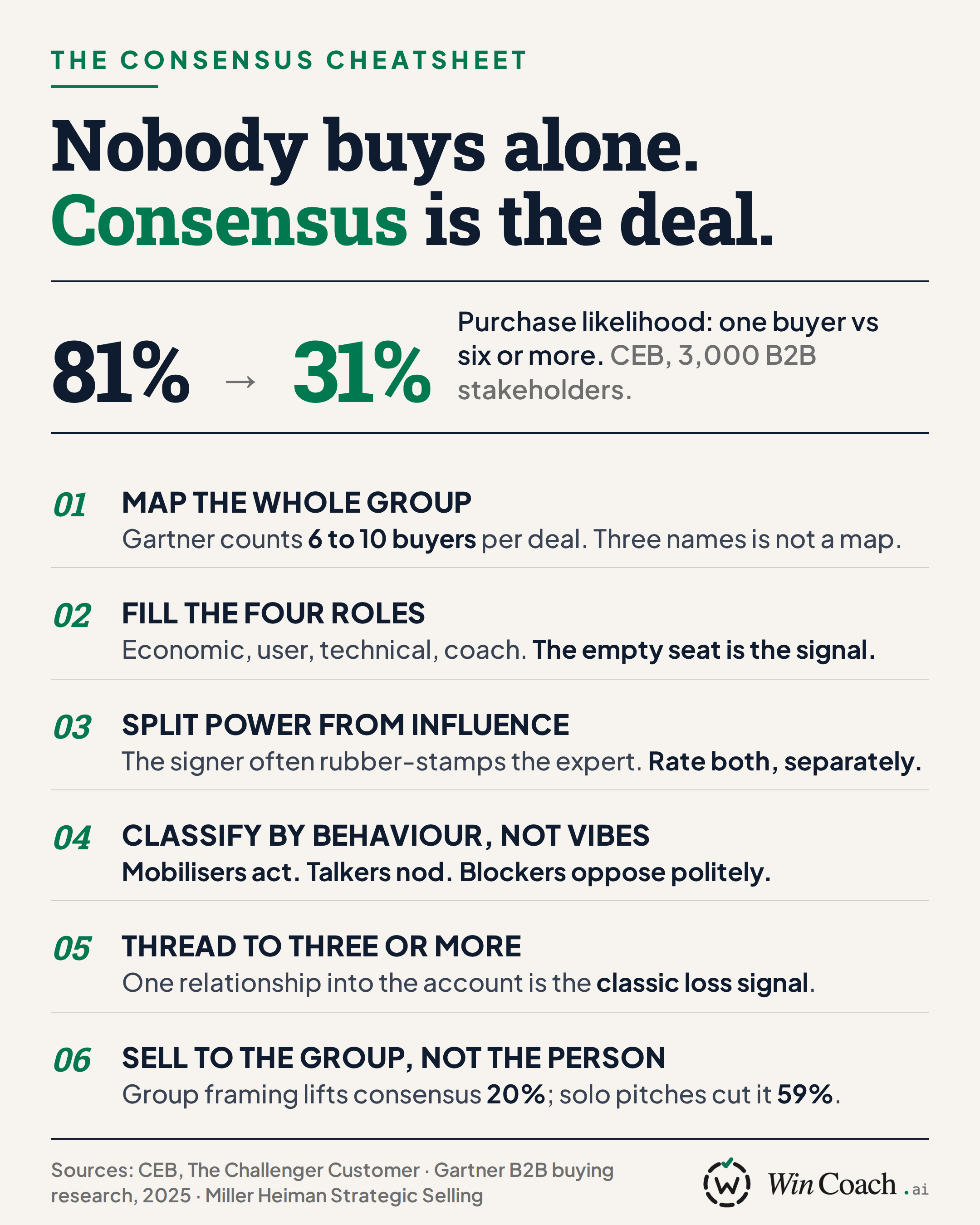
# Nobody buys alone. Consensus is the deal.
Most lost deals are not lost to a competitor. They are lost inside the buyer's own building, in meetings you never attend, between people you may never have met.
The data on this is stark. When CEB surveyed 3,000 stakeholders involved in B2B purchases for the research behind The Challenger Customer, they found that purchase likelihood with a single decision maker was 81 percent. With six or more people involved, it fell to 31 percent. Not because the product got worse. Because the group could not agree.
And six or more is now the norm. Gartner's buying journey research puts the typical complex B2B buying group at 6 to 10 people, with more recent Gartner work describing groups of 5 to 16 spread across as many as four functions. Their 2025 survey found that 74 percent of buying teams show what Gartner calls unhealthy conflict during the decision process: conflicting objectives, disagreement on the course of action, or being overruled from outside the group.
Add the finding from Dixon and McKenna's JOLT Effect research, drawn from 2.5 million sales conversations, that 40 to 60 percent of qualified deals are lost to no decision, and the picture is clear. The modern complex sale is not won by persuading a person. It is won by helping a group reach agreement. Consensus is not a stage in the deal. Consensus is the deal.
Why most stakeholder management fails
Most stakeholder maps are org charts with feelings. A grid of names and job titles, filled in once after the second meeting, ratings set by hope, never revisited. By the time the deal reaches the moment that matters, the map is silently wrong.
That version fails because it answers a question nobody asked, which is "who works there?", instead of the questions that decide deals: who is actually in the buying group, where does the power sit and where does the influence sit, who will genuinely move for us, and how exposed are we if one relationship goes quiet.
Here is what that looks like in practice. Picture a seven-figure platform deal. The seller has a strong advocate in the Head of Operations, who says all the right things in every call. The CFO, who signs, is neutral and has not been touched in nearly a month. The Chief Architect, who spent six years at the incumbent competitor, has quietly escalated integration objections upstairs, and nobody on the selling side owns that relationship. On the forecast, this deal looks healthy: an engaged champion, a live evaluation, a date in the diary. Structurally, it is one resignation or one architecture review away from dying. Everything that kills it is invisible to a map that only records names and job titles.
The six moves
These are the moves the best methodologies converge on. None of them is new. The discipline is doing all six, on every complex deal, and keeping them current.
1. Map the whole group. Gartner counts 6 to 10 buyers on a typical complex deal. If your map holds three names on a seven-figure pursuit, the deal is not qualified, it is imagined. The first job of a stakeholder map is to make the real size and shape of the buying group visible, including the people you have never met.
2. Fill the four roles. Miller Heiman's Strategic Selling gave us the durable taxonomy: the economic buyer who can release the money, the user buyers who live with the outcome, the technical buyers who can veto on standards, and the coach who reads the inside for you. Roles describe function in this decision, not job title. One person can hold two roles, and an unfilled role is itself the signal. No identified economic buyer, or no coach, is the rawest qualification gap there is.
3. Split power from influence. Formal authority and actual sway on this decision are different axes, and conflating them is the single most common mapping error. The VP who signs the contract may be rubber-stamping whatever the staff architect recommends. Rate both, separately, for every person who matters. A deal that is strong with power and absent with influence looks safe and is quietly being lost.
4. Classify by behaviour, not vibes. This is the Challenger Customer's sharpest contribution. Stance is cheap; what predicts wins is observable action. Mobilisers take internal action on your behalf: they circulate the business case, they put the project on the steering group agenda. Talkers say encouraging things and do nothing. Blockers work against you, often politely. Nobody should be classified as a mobiliser until they have demonstrably mobilised. A deal strategy built on talkers is a deal strategy built on air.
5. Thread to three or more. Single-threading, one genuine relationship into the account, is among the most reliable loss predictors in complex sales. The supporting win-rate figures are largely vendor-originated, so treat the precise uplift as directional, but the mechanism is not in doubt: one thread means one resignation, one reorganisation, or one bad week ends the deal. Threading should be counted from real relationships, not asserted because several people attended a demo.
6. Sell to the group, not the person. This is the counterintuitive one, and it is load-bearing. Gartner's 2025 buyer survey found that content tailored for buying-group relevance improves consensus by 20 percent, while content tailored to individual-level relevance damages it by 59 percent, because it reinforces each stakeholder's existing position and pulls the group apart. The instinct to give each stakeholder a personalised pitch is precisely backwards. Your job is to give the group a shared frame they can agree inside. Gartner also found that groups reaching consensus are 2.5 times more likely to call the resulting deal high quality. Buyers who agree do not just buy more often; they buy better.
The real distinction
Notice what runs through all six moves: none of them is about persuasion. They are about visibility and orchestration. The naive seller asks "how do I convince each of these people?" The effective seller asks "what is preventing this group from agreeing, and what would remove it?"
That reframe matters because the buying group's hardest work happens when you are not in the room. Gartner's research has long shown that buyers spend a small fraction of their purchase journey, around 17 percent, meeting with all potential suppliers combined. The consensus battle is fought internally. The best sellers arm their mobiliser to fight it, with a group-level case, rather than trying to fight it themselves one stakeholder at a time.
What would actually fix this
Independent of any tool, the fix is structural. The stakeholder picture needs to be a living record, not a one-off exercise: power and influence rated separately, classifications backed by observed behaviour rather than optimism, threading counted rather than claimed, and the whole thing revisited every time the deal moves. The hard part is not knowing this. It is sustaining it across a full pipeline when every seller is busy and every map decays the moment it is written.
That is the problem WinCoach is built for. The deal team tells WinCoach what they know in plain language; a proprietary 28-dimension framework reads those signals, including buying-group coverage, threading depth, and influence-weighted stance, and returns the next best move, written for the role asking. The seller gets what to do today. The manager gets the conversation for the 1:1. The leader sees where the quarter really stands. No static map, no rating by hope.