Conversation Intelligence Tells You What Happened. It Cannot Tell You What Is About to Go Wrong.
Here is a pattern I see constantly. A deal looks healthy on every recorded call. The buyer is engaged, the questions are good, the sentiment scores well. Then it goes quiet, slips a quarter, and ends in no decision. Nobo
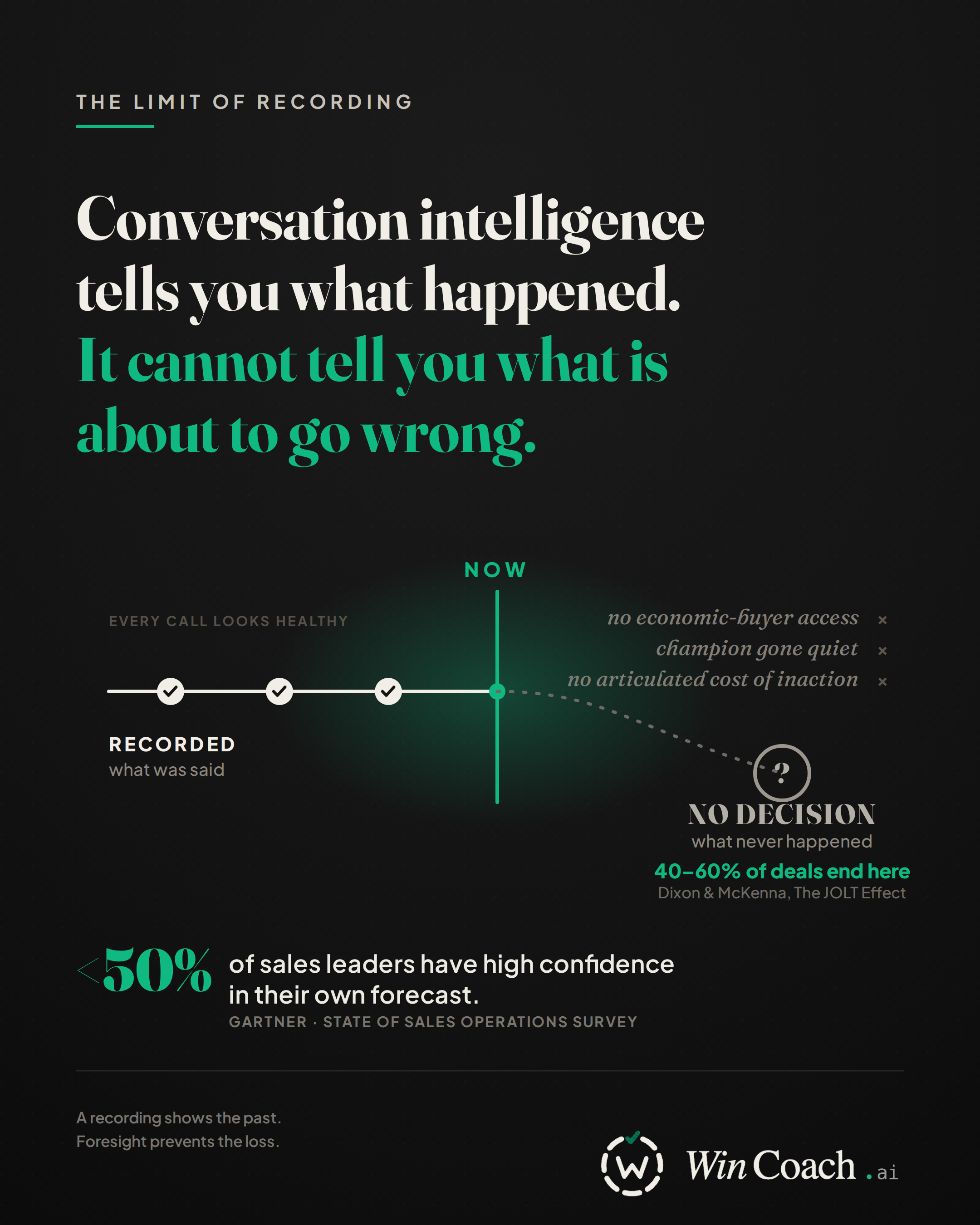
Here is a pattern I see constantly. A deal looks healthy on every recorded call. The buyer is engaged, the questions are good, the sentiment scores well. Then it goes quiet, slips a quarter, and ends in no decision. Nobody chose a competitor. The deal simply died, and the call recordings never saw it coming.
That is not a failure of the recording. It is the structural limit of what a recording can do.
Conversation intelligence, by its own definition, records, transcribes, and analyses what was said on a call. The category leaders describe themselves this way. It is, in effect, a search engine for what was talked about. That is genuinely useful, and I want to be fair to the category before I argue with it.
But notice what that definition contains. A conversation intelligence tool can only reason over what entered the transcript. And deals rarely die of something that was said. They die of absences. No access to the economic buyer. A champion who has gone quiet. A cost of inaction that was never articulated, so the buyer feels no real reason to move now. A procurement step that should have started three weeks ago and did not. Single-threading into one friendly contact who cannot actually sign.
A transcript cannot capture an absence. It records the meeting that happened, not the meeting that should have happened and did not. So the tool is structurally blind to the part of the deal where the risk actually lives.
This is the difference between analysis and foresight, and the two get blurred constantly. Analysis explains a call that already occurred. Foresight compares the live deal against a model of what should be true at this stage, and flags what is missing before it becomes a slip. Recording the present is not the same as predicting the future. A perfect record of the road behind you tells you nothing about the curve ahead.
I want to be careful here, because the honest version of this argument is stronger than the cheap one. The JOLT Effect, the most important recent research on why deals stall, was built on conversation intelligence. Dixon and McKenna analysed roughly 2.5 million recorded sales calls. That work is how the field learned that somewhere between 40 and 60 percent of forecasted deals are lost to no decision rather than to a competitor, and that most of those losses come from buyer indecision and fear of getting it wrong, not a preference for the status quo. Conversation intelligence is a brilliant microscope on the past. The mistake is confusing the microscope for the cure.
Here is the trap in practice. The deals that die of indecision are precisely the ones that sound healthy on the recordings. By the time hesitation is actually audible in a transcript, the slip is already underway. Review tells you why you lost, after you have lost. It cannot intervene before the conversation that would have changed the outcome.
So conversation intelligence is strong for review and weak for prevention. It is excellent for onboarding a new rep on what good looks like, for settling what was actually promised, for studying your top performers. None of that is prevention. Prevention happens before the call that never got booked.
What a forward-looking coaching layer adds is the part a recording cannot provide. Three things, specifically. First, a model of winnability: a defined view of what should be true at each stage, so the system knows the economic buyer meeting is missing rather than waiting for someone to mention it. Second, memory across the whole pursuit, weeks of it, not a single call, because the signal that matters is usually the gap between calls. Third, a next move while there is still time to make it. Not a summary of yesterday. Something closer to: reach the economic buyer this week, through your sponsor, before the proposal goes in.
The proof that the recording era has not solved this is in the forecast. Gartner found that fewer than half of sales leaders and sellers have high confidence in their own forecast accuracy. We record and analyse more conversation than at any point in history, and confidence has not moved, because none of it answers the only question that matters on a live deal. What is about to break, and what do I do about it this week.
A recording shows you the past. Foresight is what prevents the loss.