Gut Feel Is Real Skill. It Is Also Unrepeatable and Uncoachable
Gut feel is real skill. It is also unrepeatable and uncoachable. The best senior reps run on instinct. They read a room, sense when a deal is drifting, and know which thread to pull before anyone has said why. That insti
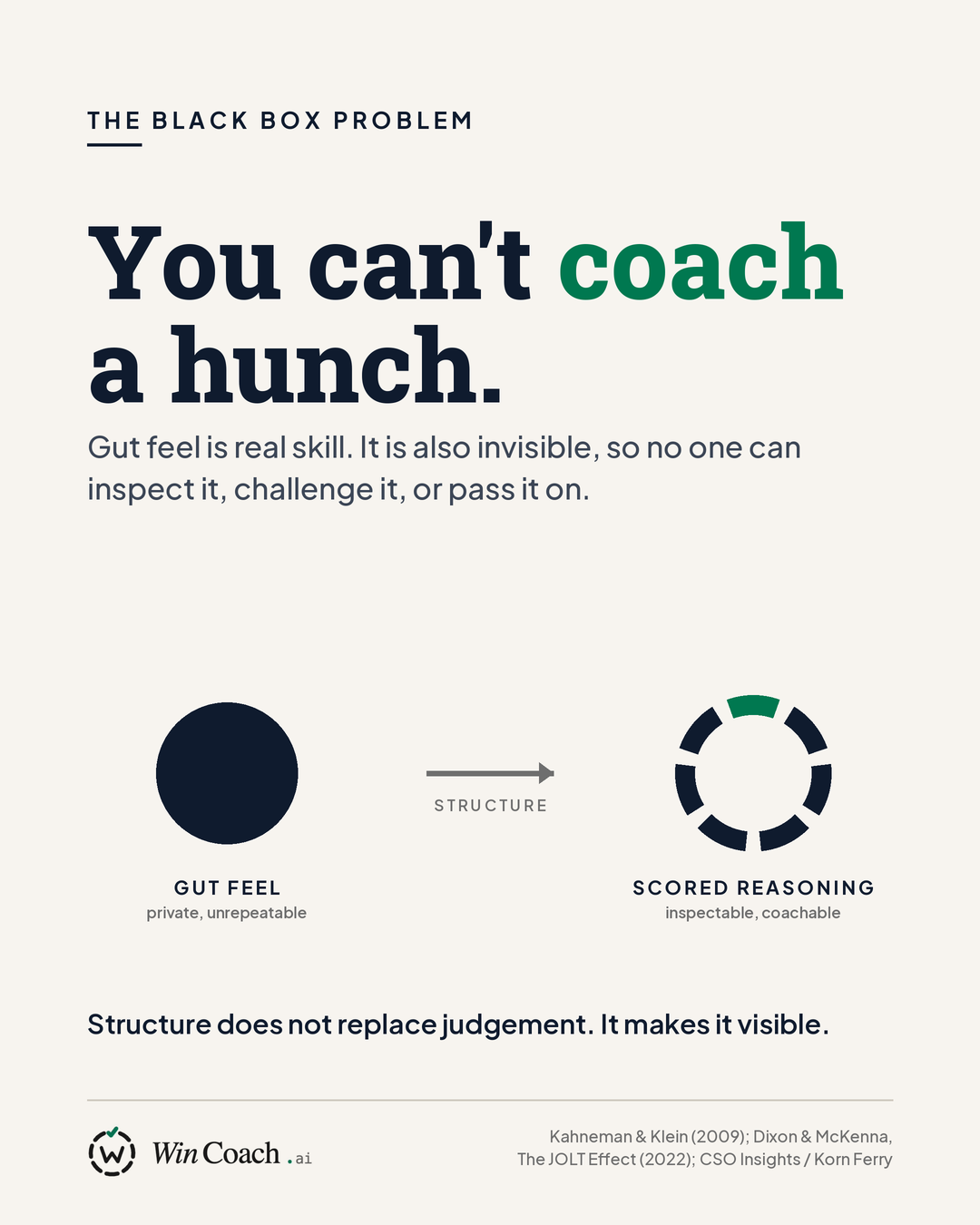
Gut feel is real skill. It is also unrepeatable and uncoachable.
The best senior reps run on instinct. They read a room, sense when a deal is drifting, and know which thread to pull before anyone has said why. That instinct is real skill, earned across hundreds of deals. I am not here to dismiss it.
But it has two flaws that quietly cost teams money. It cannot be transferred to anyone else. And it cannot be corrected, even when it is wrong.
Why instinct is real, and why that is not enough
Expert intuition is not magic. It is pattern recognition, built by seeing similar situations again and again until the brain matches them automatically. Daniel Kahneman and Gary Klein, two researchers who spent their careers on opposite sides of the judgement debate, agreed on this in their 2009 paper for American Psychologist.
They also agreed on something less comfortable. Intuition can only be trusted under two conditions. The environment has to be regular enough to hold genuine patterns, and the person has to have had enough chances to learn those patterns through fast, clear feedback. They call the first condition a high-validity environment. Where it is missing, intuition becomes unreliable, and, this is the part that matters, confidence stops tracking accuracy. People hold shaky judgements with great conviction and state them assertively, so others believe them more than the evidence warrants.
Complex B2B selling sits a long way from that ideal. Deals take months. Outcomes have many causes at once: a champion changes role, a budget freezes, a competitor moves, the timing slips. The feedback that would sharpen a rep's instinct arrives late, rarely, and tangled together. A rep can carry the same flawed read for years and never get the clean signal that would correct it.
The hidden cost, in a deal you will recognise
Picture a strong account executive, consistently near the top of the board. They have a habit. They trust the champion to carry the deal internally, so they engage the economic buyer late, if at all. Most quarters this is fine. The champion is good and the deal lands.
Then a big one dies in procurement. The post-mortem records the reason as "budget". Two quarters later, another stalls the same way. Again, "budget", or "timing". Each loss has a plausible local story, so no one connects them. The rep least of all, because the blind spot lives inside the very instinct making the call. From the inside, the pattern is invisible.
There is a second cost, and it lands when your best rep leaves. Their judgement took years to build. Average rep tenure in B2B is short, somewhere around one and a half to two years on the common benchmarks, and ramping a new rep to full productivity takes months, longer for larger deals. When the senior rep walks out, the playbook walks out with them. It was never written down, because no one could write it down. The next rep starts the clock from zero.
The distinction almost everyone gets wrong
The usual framing is structure versus judgement. Process versus gut. And the usual fear is that structure handcuffs your best people. That is the wrong axis entirely.
The problem with gut feel is not that it is wrong. Often it is right, which is exactly why it survives. The problem is that it is invisible. You cannot inspect a hunch. You cannot challenge it in a one-to-one. You cannot hand it to a colleague. And the rep cannot audit their own, because, as Michael Polanyi put it decades ago, we know more than we can tell.
So the real distinction is not structure versus judgement. It is visible reasoning versus invisible reasoning. Everything that makes instinct uncoachable comes back to one fact: no one, including its owner, can see it.
What actually fixes this
The fix is not to overrule senior judgement. It is to make it explicit. You get the reasoning out of the rep's head and onto a consistent surface, at the moment of the decision, in terms specific enough to argue with.
Two things follow.
First, a manager can finally coach the judgement itself rather than the activity log. This matters because coaching only pays off when it is structured. CSO Insights, now part of Korn Ferry, found that a dynamic coaching process, one tied to a defined method and reinforced over time, improved win rates on forecast deals by around 28 percent, while the ad hoc approach most teams default to delivered little. You cannot run structured coaching on an input no one can see. A CRM field tells you what the rep did. It never tells you whether their reasoning was sound, and it certainly never challenges it.
Second, once the reasoning is captured the same way across many deals, patterns surface. The recurring blind spot that was invisible in any single deal becomes obvious across ten. This is the lesson of The JOLT Effect in another register. Matthew Dixon and Ted McKenna analysed around 2.5 million sales conversations and found that 40 to 60 percent of qualified pipeline is lost to no decision. The high performers who beat that did not have a sharper sixth sense. They followed a specific, observable set of behaviours that could be named and taught. Skill that looks like mystique is usually a pattern waiting to be made explicit.
How WinCoach does this
This is what we built WinCoach to do. The deal team tells WinCoach what it knows in plain language. The framework behind it, 28 dimensions across 7 pillars of deal winnability, reads those signals and returns scored reasoning and a written next best action. Instinct becomes explicit and inspectable. A manager can challenge a weak dimension directly in the one-to-one, which a CRM field never invites. Score history across deals surfaces the recurring blind spot a rep could never see in themselves. And the output is role-aware: the seller gets the next move, the manager gets the conversation to have and who to coach, the leader gets an honest read on where the quarter really stands.
Structure does not replace your senior people's judgement. It makes that judgement visible, so it can finally be inspected, challenged, improved, and passed on.
WinCoach is in private beta. If that is a problem you are trying to solve, you can request early access at wincoach.ai.