Sales coaching drives higher win rates, but coaching is hard to scale
There is no real argument left about whether sales coaching works. That debate ended years ago. What remains is a stranger and far more expensive problem. Almost no one delivers coaching consistently across a team. Not b
There is no real argument left about whether sales coaching works. That debate ended years ago. What remains is a stranger and far more expensive problem. Almost no one delivers coaching consistently across a team. Not because leaders doubt the value. Because they cannot find the hours.
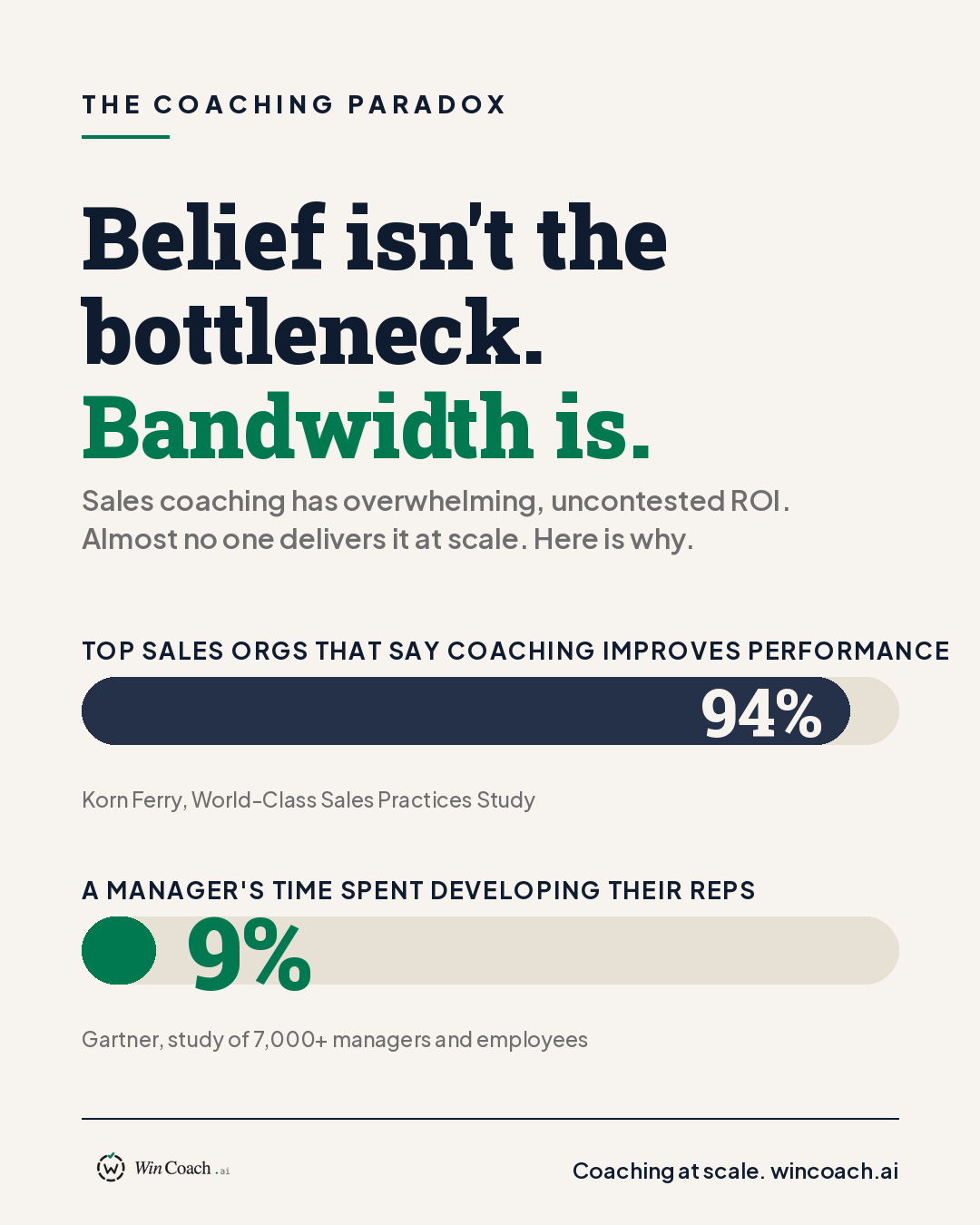
This matters because the value is not in dispute and it is not small. In Korn Ferry's World-Class Sales Practices Study, 94 percent of top sales organisations said coaching improved their sellers' performance. That is about as close to consensus as this profession produces. The return is also concentrated in a useful place. CEB's Sales Executive Council, the research body behind The Challenger Sale, found that the best coaching lifts the performance of the middle 60 percent of reps by up to 19 percent, while average coaching moves them about 8 percent. Top and bottom performers barely shift. In other words, the largest, most coachable part of your team is where the money sits, and good coaching is the lever that reaches it.
The same body of research adds a second point that is easy to miss. Combining training with coaching is roughly four times more effective than training alone. Coaching is not a nice-to-have layered on top of enablement. It is the part that makes everything else stick. Korn Ferry's enablement work points the same way. Organisations with consistent coaching and impact measurement reported around 32 percent higher win rates and 28 percent higher quota attainment than the study average. Gartner puts the headline lift from effective coaching at roughly 8 percent of sales performance. The numbers vary by study, as they should. The direction never does.
So belief is settled and the evidence is strong. Here is the part that quietly breaks.
Gartner studied this across more than 7,000 employees and managers, spanning 18 functions and 25 industries. The finding is blunt. The average frontline sales manager has seven direct reports and spends just 9 percent of their time developing them. Worse, 42 percent of managers say they lack the confidence to build the skills their people need today, and only 38 percent of reps say their manager actually helps them develop for their current role.
Picture the manager this describes, because you have met them. Seven reps. A number to hit this quarter. Monday is the forecast call. Tuesday is escalations. Wednesday and Thursday are pipeline reviews dressed up as coaching, the ones where the question is "what is the status of this deal" rather than "what does this buyer need to believe to move." The four reps in the middle, the exact group the research says would gain the most, get a few rushed minutes between fires. The 19 percent stays on the table. Not for one quarter. For every quarter.
Now the distinction that almost everyone gets wrong.
This problem gets diagnosed as a belief problem or a skill problem. The belief reading says managers do not value coaching enough, so we run a campaign to convince them. The skill reading says managers do not coach well enough, so we send them on a course. Both miss the mechanism, because both assume the constraint is the manager's attitude or ability. The real constraint is the clock. You cannot train your way out of a time constraint. Seven reps, coached individually, well, and consistently, is more hours than the role contains once you subtract the forecast, the escalations, the hiring, the reporting, and the deals the manager is personally carrying.
And there is a sting in the data that makes "just coach more" actively dangerous. CEB found that poor coaching can hurt performance nearly twice as much as good coaching helps. So piling rushed, inconsistent coaching onto an overloaded manager is not a neutral move. It can do real damage. The bottleneck is not whether managers believe in coaching, and it is not even whether they are good at it on a good day. It is that high-quality, individual, consistent coaching simply does not fit inside one human's week when it has to be repeated across every rep and every live deal. Reframe it and the solution changes shape. This is a scale problem. Scale problems are solved with structure, not with motivation.
If the constraint is human bandwidth, then three things have to change, and none of them is "ask managers to try harder."
First, the routine diagnosis has to become continuous. The basic questions, what is actually wrong with this deal and what should happen next, cannot wait for a slot in a calendar that does not have one. They have to be available the moment a rep needs them.
Second, the diagnosis has to hold a consistent quality floor. A rep's development should not depend on the luck of which manager they were assigned, or whether that manager had a good week. Inconsistent quality is the thing that turns coaching from an asset into a coin toss.
Third, the human's scarce hours have to be protected for what only a human can do. Judgement on the genuinely hard calls. Motivation. Trust. The conversation in the room that no framework can have for you. Structure should carry the routine so people can carry the irreducible.
That is what coaching at scale actually means. Not more hours squeezed from managers who do not have them. Fewer hours wasted on the routine, so the human hours land where they count.
This is the problem WinCoach is built for. The deal team captures what they know about a live deal in plain language through. A proprietary framework, 28 dimensions across seven pillars of deal winnability, reads those signals and returns a synthesised next best action, written for the role asking. The rep gets what to do today on this deal. The manager gets who to coach this week and the conversation to have in the 1:1. The leader gets where the quarter really stands. The diagnosis runs continuously and to the same standard for every rep, so the coaching return stops depending on a manager's spare time. The scarce human hours go where they belong. The case for coaching was won a long time ago. The thing standing between that case and your pipeline was never belief. It was bandwidth. Solve the bandwidth problem with structure, and the 19 percent stops being a statistic you nod at and starts being a number you bank.