Sales Managers and Leaders - You Cannot Coach a Deal You Cannot See
TL;DR Managers do not see deals directly; they see the seller's version of the deal. Because sellers naturally present the inside view, often optimistic and incomplete, managers inherit the bias they are meant to correct
TL;DR
Managers do not see deals directly; they see the seller's version of the deal. Because sellers naturally present the inside view, often optimistic and incomplete, managers inherit the bias they are meant to correct. The result is predictable: risks that were visible all along only become obvious after a deal slips or dies. The fix is a consistent assessment applied to every deal, every week, so managers can compare deals against the same bar, spot risk early, and coach from evidence rather than narrative. WinCoach exists to make that disciplined way of seeing practical at scale.
You Cannot Coach a Deal You Cannot See
Every deal review runs on the same hidden assumption: that the manager is looking at the deal. They are not. They are looking at the seller's account of the deal. Those are two different objects, and the gap between them is where most losable deals are lost.
A manager's entire picture of a deal is assembled from what the seller chooses to say. Not from malice, and rarely from outright dishonesty. Simply because the seller's words are the only window available. Whatever the seller leaves out, the manager cannot see. And what a manager cannot see, a manager cannot coach.
Why this is structural, not a people problem. Sellers are optimistic about their own deals for the same reason we are all optimistic about our own plans. Daniel Kahneman and Amos Tversky named this the planning fallacy in 1979: when we forecast our own work, we build the estimate from the best case and quietly discount the obstacles. Kahneman and Lovallo later extended the idea in Harvard Business Review, and it holds up wherever it has been tested. We take what they called the "inside view", the story of how this particular deal goes well, rather than the "outside view", the base rate of how deals like this actually turn out.
Here is the part that matters for managers. The research is consistent that this optimism is strongest for our own tasks. Detached observers tend to judge more realistically. In principle, that detached observer is the manager. The manager is meant to be the outside view that corrects the seller's inside view. But the manager only ever receives the inside view, in the seller's own words, so they inherit the optimism instead of correcting it. The one person positioned to see the deal clearly is handed a version already tilted toward the best case. The analogy is mine; the original studies measure task-completion time, not deal outcomes. The mechanism, though, travels well.
The numbers downstream are what you would expect. CSO Insights, now part of Korn Ferry, found that the win rate of forecasted deals is 46.9 percent. Less than half of the deals a team commits to actually close. Salesforce's State of Sales reports that 84 percent of sellers missed quota last year, and that only around a third of sales professionals trust the accuracy of their own pipeline data. Surprises are not the exception in most pipelines. They are the operating condition.
The hidden cost, in a deal you will recognise. Picture a deal that looks healthy for a quarter. Every week the seller reports movement: the champion is engaged, budget is confirmed, there is a verbal yes. The manager has nothing to push against, because every data point in the review is the seller's own, framed the seller's own way. Then the deal goes quiet. A competitor lands, or procurement stalls, or the champion changes role, and the deal slips or dies.
Look back, and the warning signs were there from the start. The deal was single-threaded to one contact. No one had met the economic buyer. There was no mutual plan with dates the buyer had actually agreed to. The close date had moved twice. None of that was hidden. It simply never surfaced in a form the manager could see and question. This is the same deal that reappears at month end, rescued by the "hero" seller, and prompts the honest question no one enjoys asking: why was this not in the forecast you gave me three weeks ago?
The distinction most reviews miss. The problem is not that sellers lie. It is that a narrative is not a diagnosis. A story can be completely sincere and still be impossible to test, because there is nothing in it a manager can independently check. Coaching needs something both people can look at together. The real distinction is between a description, what the seller says is true about this deal, and an assessment, the same questions asked of every deal so that the answers actually mean something next to each other. A description tells you how the seller feels. An assessment tells you where the deal is weak.
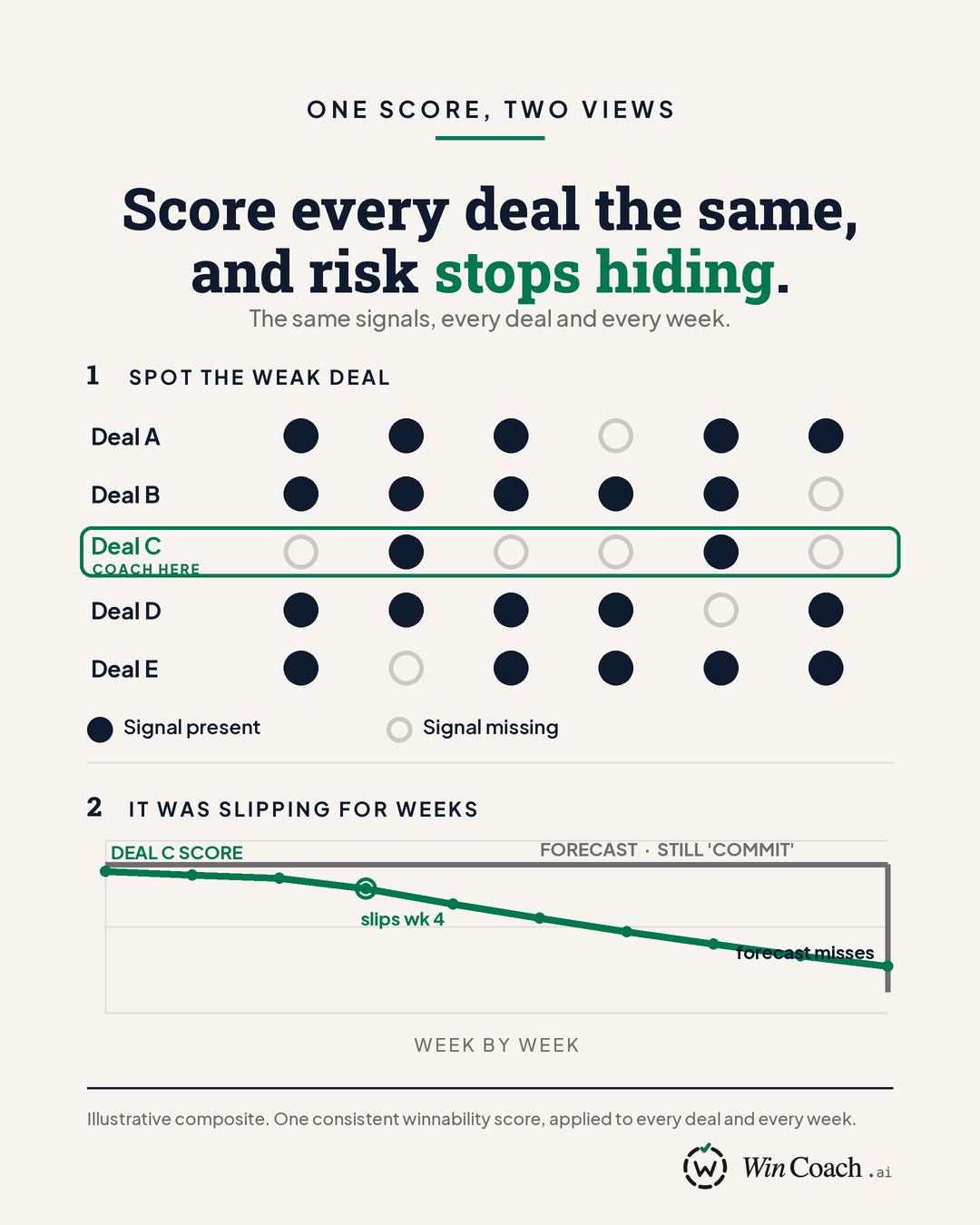
What actually fixes this. Apply one consistent assessment to every deal. The same dimensions, every time, for every seller. Two things change immediately, and neither of them depends on any particular tool.
First, the picture becomes comparable. A deal is no longer strong because it was described well. It is strong or weak against the same bar as every other deal in the pipeline. The seller who narrates confidently and the seller who undersells are measured the same way, so the manager can finally tell the difference between a good deal and a good storyteller.
Second, risk becomes a leading indicator instead of a lagging one. A low score, or a score that is drifting down week on week, shows up long before a missed forecast does. The manager stops reacting to the story and starts coaching from the specific gaps the assessment exposes: no economic buyer, single-threaded, no agreed next step. That is a coachable conversation. "I have a bad feeling about this one" is not.
You can build a version of this with a spreadsheet and real discipline. The method matters more than the software. What is hard is applying it consistently, to every deal, every week, without it decaying into a box-ticking exercise. That is the actual work.
How WinCoach does this. WinCoach applies a proprietary framework of 28 dimensions across seven pillars of deal winnability to every deal in the pipeline. The deal team tells WinCoach what they know in plain language, and the framework reads those signals and returns a synthesis written for the person asking. The manager sees where each deal is thin, which deals are drifting down, who needs coaching and on what, and the conversation worth having in the next one-to-one.
It is a different instrument from the ones most teams already own. A forecasting tool gives you a score but not the reason behind it. Conversation intelligence tells you what was said on the calls it recorded. CRM AI summarises the records. WinCoach differs on three counts: it runs on a proprietary framework rather than a generic prompt, it draws on signals from the whole deal team rather than system logs alone, and it produces a different answer for the seller, the manager, and the leader. For the manager, that answer is simple: here is the deal underneath the story, and here is where to coach.
You cannot coach a deal you cannot see. The fix is not more reporting. It is a consistent way of seeing.