The Deal Does Not Live in the CRM. It Lives in the Seller's Head.
Open any CRM and you will find a tidy version of your pipeline. Stages, close dates, amounts, next steps, a forecast category. It looks like the deal. It is not the deal. It is a record of the deal, filed after the fact.
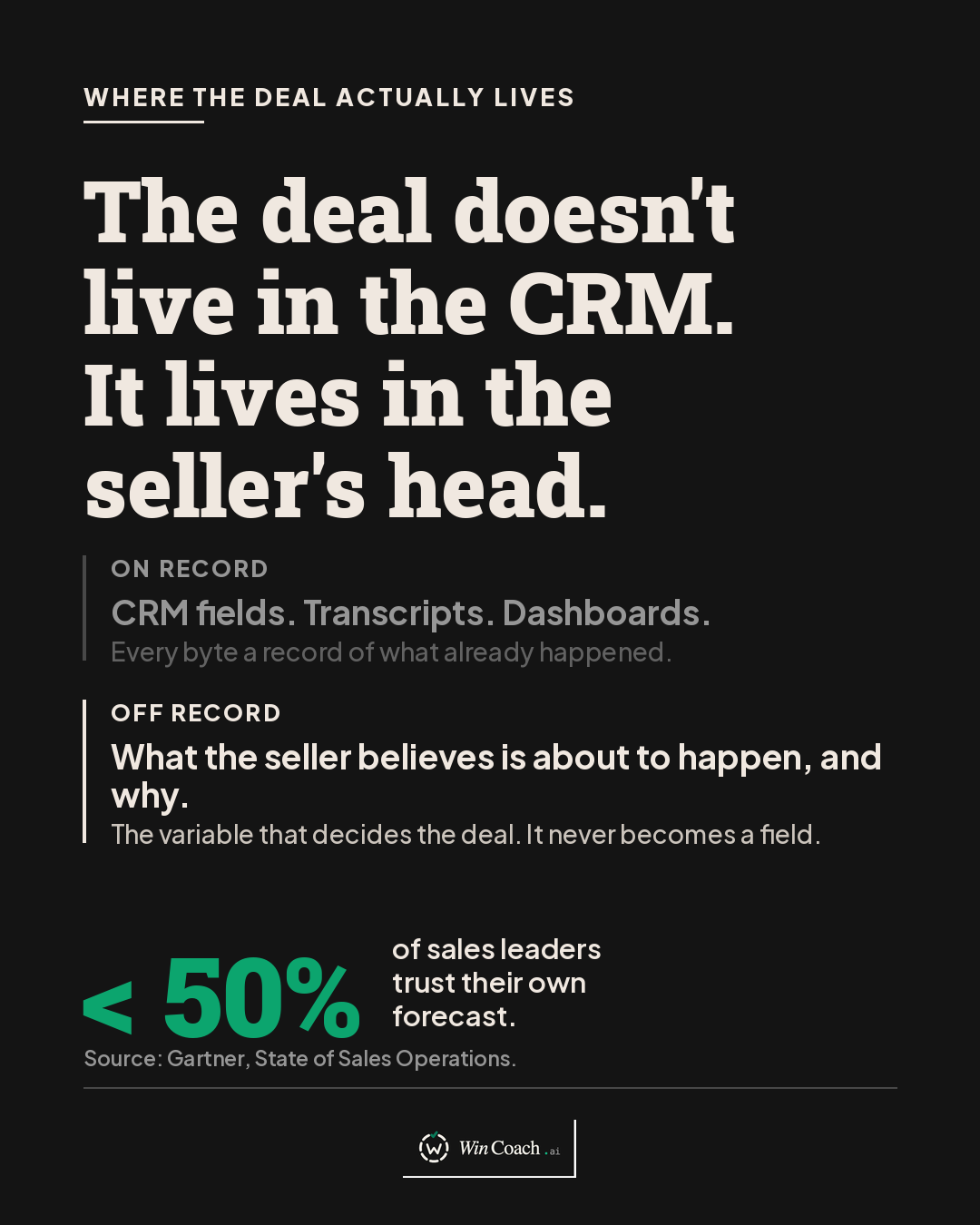
Open any CRM and you will find a tidy version of your pipeline. Stages, close dates, amounts, next steps, a forecast category. It looks like the deal. It is not the deal. It is a record of the deal, filed after the fact. The deal itself, the thing that decides whether you win, lives somewhere your systems cannot reach: in the seller's head, in the form of a judgment about what is about to happen and why. That distinction sounds academic until you sit in a forecast call. Then it costs you.
The systems of record only ever hold the past
Your CRM, your call transcripts, and your dashboards have one thing in common. They all describe what has already happened. A logged stage change is history. A transcript is a recording. A dashboard is yesterday rolled up and colour-coded. None of them tells you what the seller believes will happen next, which is the only variable that actually moves a forecast.
The data on its own does not inspire confidence, and the people relying on it know it. Gartner's State of Sales Operations research found that fewer than half of sales leaders and sellers, around 45 percent, have high confidence in their organisation's forecasting accuracy. One of the biggest reasons is data quality: only 47 percent believed their organisation had high-quality data to work with (Gartner, 2020). So we have built an elaborate apparatus to capture the deal, and most leaders still do not trust what it tells them.
It gets harder when you remember how little the seller sees in the first place. Gartner's buying research shows B2B buyers spend only about 17 percent of their total buying time meeting with potential suppliers, and the time given to any single sales rep can be as low as 5 to 6 percent. Most of the decision happens in rooms you are not in. The seller's read on that invisible majority, the politics, the silence from the economic buyer, the competing priority nobody has named, is the most valuable information in the deal. It is also the information least likely to survive contact with a CRM field.
The hidden cost shows up on the deals that look safest
Picture a deal marked Commit. Every field is filled. The close date is this quarter, the amount is locked, the last call transcript is full of warm language, and the dashboard shows it green. By every recorded measure, it is a strong deal.
The rep knows otherwise. The champion has gone quiet for ten days. The economic buyer skipped the last two sessions. There is a reorganisation rumoured for next month that could freeze the budget. None of that is a field. There is no dropdown for "I think this slips, and here is why." So the rep does what reps do under pressure: leaves it on Commit, hopes, and privately puts it at maybe forty percent. The system says ninety. The seller's head says forty. The number nobody can see is the true one, and the forecast is built on the other.
This is how good teams get surprised by deals they were watching closely. The watching was real. They were just watching the wrong layer.
Analysis is not foresight
Here is the distinction most tools miss. Recorded data is very good at telling you what happened. It is structurally incapable of telling you what is about to go wrong. Conversation intelligence can tell you what was said on the call. It cannot tell you what the buyer is privately weighing on the drive home. That gap is where deals are won and lost.
The clearest evidence is the way modern deals actually die. Research by Matthew Dixon and Ted McKenna, drawn from 2.5 million recorded sales conversations and published in The JOLT Effect, found that between 40 and 60 percent of qualified pipeline is lost not to a competitor but to no decision. The customer simply does not move. Of those stalled deals, 44 percent come from a preference for the status quo, and 56 percent come from the buyer's own fear of getting the decision wrong. None of that is a competitive loss your CRM can flag in advance. It is a forward-looking risk that sits in human judgment, the buyer's and the seller's, long before it ever becomes a closed-lost record.
So the decisive question in any complex deal is not "what does the data say happened." It is "what does the person closest to this deal believe is about to happen, and how good is that belief." That is forward-looking judgment. It is the actual unit of deal quality.
The fix is to coach the judgment, not reverse-engineer it
Most sales technology tries to reconstruct the seller's judgment from the outside. It scrapes activity, scores signals, and infers a probability. That is reverse-engineering, and it is always one step behind, because the signal it needs most was never logged.
The honest fix is simpler and harder. Capture the seller's forward judgment directly, in their own words, while it is fresh. Make the read explicit: what do you think happens next, who is for you, who is against, what is the one thing that could kill this. Then structure that judgment so it can be examined, challenged, and coached, rather than left as a private hunch the manager only hears about when the deal is already gone. Coaching the judgment beats inferring it, because you are working on the real variable instead of a proxy for it.
This is also where coaching earns its name. A pipeline review that only interrogates the CRM is forecast theatre. A review that interrogates the seller's reasoning, surfaces the weak assumption, and changes the next move is coaching. The first manages the record. The second changes the outcome.
How WinCoach does this
WinCoach is built on the premise of this article. The deal team tells WinCoach what it actually believes, in plain language, through "Tell WinCoach". A proprietary 28-dimension framework across seven pillars of deal winnability reads those signals and returns a synthesised next best action, written for the role asking. The seller gets what to do today. The manager gets the conversation to have in the one-to-one and who to coach. The leader gets where the quarter really stands and where to engage. It runs on that framework rather than a generic prompt, it draws on the judgment of the whole deal team rather than system logs alone, and it produces a role-aware answer rather than one dashboard for everyone. It works on the layer where the deal actually lives.
The record will always tell you where the deal has been. The job is to get good at the only thing that changes where it goes next: the judgment in the seller's head, made explicit, and coached.